
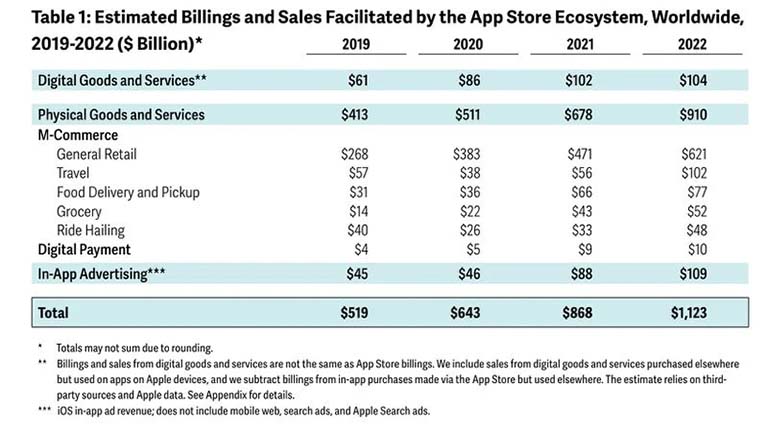
The App Store was responsible for about $1.1 trillion in billings and sales made by developers in 2022, according to a study funded by Apple itself and conducted by economists at the Analysis Group. Apple shared the results of the study as part of an ongoing effort to highlight the benefits of the App Store and the successes of developers using its platform.
A total of $910 billion, of the $1.1 trillion, came from sales of physical goods and services made outside the App Store, while $109 billion came from in-app advertising and $104 billion from digital goods and services. The estimate includes sales from businesses of all sizes, large and small. For physical goods and services, Apple did not collect a commission.
The US giant charges a 15 to 30 percent commission on app purchases, in-app purchases and subscriptions made through the App Store. However, it doesn’t collect a commission when customers do things like buy physical goods online or pay for an Uber ride using an Apple device. Note that in the terms of the study, “charges” refers to in-app purchases, in-app purchases, and subscriptions, while “sales” refers to goods and services. “We’ve never been more optimistic about — or more inspired by — the incredible community of developers around the world,” said Tim Cook, Apple CEO.
“As this report shows, the App Store is a vibrant, innovative marketplace where opportunity thrives, and we’re more committed than ever to investing in the success of developers and the future of the app economy.” There was a 29% increase in developer fees and sales over the previous year, with travel and mobility services showing the most notable increase.
The App Store has seen steady growth in recent years, going from $643 billion in 2020 to $868 billion in 2021, before surpassing $1 trillion in 2022.
The Analysis Group points out that direct app monetization is a “tiny fraction” of commerce facilitated by the App Store, with developers able to make a profit through ad-supported content, sales of goods and services outside the App Store, and and physical goods and services. The study suggests that beyond in-app purchases and subscriptions, the App Store provides a “trusted platform” for businesses to sell their products, and points to the many policies Apple has implemented to “enhance user trust” ” and the prevention of fraudulent transactions. In the 15 years since the App Store launched, developers have earned a total of $320 billion directly from the app store.
Today there are 123 times more apps available compared to the end of 2008, with more than 370 billion app downloads since the store launched. Games make up the largest share of applications, followed by business and educational applications. This is the second Analysis Group study Apple has shared this month, with the previous study focusing on the successes of small businesses in the App Store. The new study offers a broader look at the overall platform ecosystem.
Analysis Group has been providing similar reports on Apple since 2020 as the company battles App Store regulations in several countries. The two studies published in May come amid rumors that Apple plans to start supporting sideloading in Europe after the release of iOS 17. The Digital Markets Act requires Apple to allow European customers to acquire apps outside of App Store and use alternative payment methods and Apple should allow sideloading until 2024.
Apple has argued against sideloading because it bypasses the protections offered by the App Store and would require a complex system where Apple would collect a reduced commission from developers outside of its own store. Sideloading will reportedly only be available in Europe where it is mandatory, but other countries are considering similar legislation and Apple is no doubt hoping to discourage regulators from adopting similar laws. In the United States, for example, the Open App Markets Act and the American Innovation and Choice Online Act would allow developers to use non-Apple app stores and alternative payment systems.
Widely publicized studies like this one reinforce Apple’s narrative about the size of the App Store ecosystem and the potential consequences of not using it.
0 Comments