
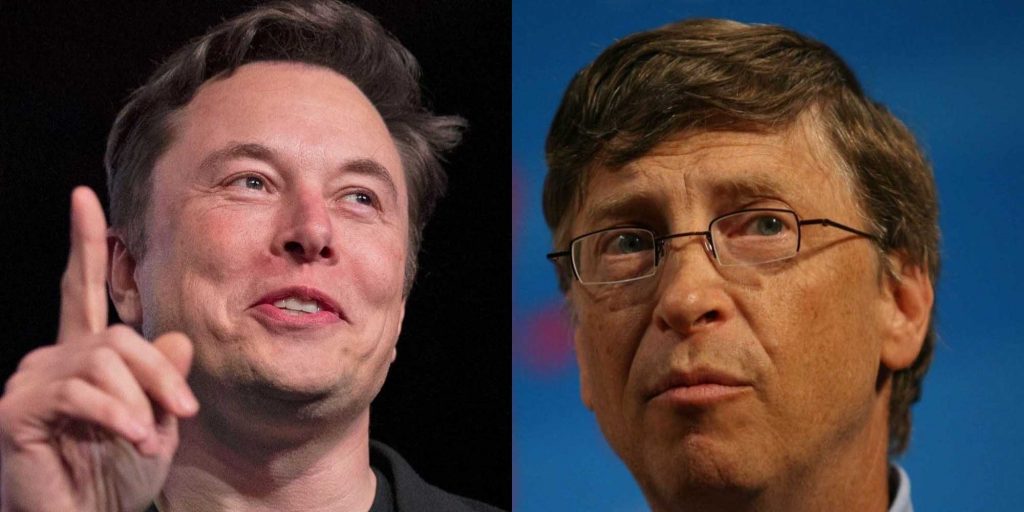
The founder of Tesla threatens to “crush” Gates if the latter does not stop shorting his company. Elon Musk issued a warning to Bill Gates on Thursday, asking him to stop playing with him.
The Microsoft co-founder risks disaster if he tries to bet against Tesla again. That’s because Musk is confident he can transform the company into an AI giant with a market valuation of $30 trillion as soon as Tesla completes its transition from primarily making and selling electric vehicles to manage a profitable fleet of robot taxis and humanoid robots.
The feud between the two became public when a communication between them was leaked in 2022, in which Musk refused to support Gates’ philanthropic work, having been informed that he still had half a billion dollars on the prediction that Tesla’s stock would record a downward trajectory . By the time these messages leaked, Gates was already beginning to regret his stance on Tesla. It remains unclear whether he still has money tied up in the stock’s future performance.
Musk’s warnings that those shorting Tesla stock will be “wiped out” are a bold claim, however, at a time when the company he leads is on track for the worst performance in 2024 among the S&P 500. In the first half of the year, Tesla’s sales are down 6.6%. The Cybertruck has struggled to live up to the high expectations that had been cultivated, while Musk earlier decided to shelve Tesla’s much-touted goal of boosting sales from 1.8 million vehicles to 20 million by 2030. Musk, however, is not one to back down in the face of adversity, and has been known to sideline other well-known investors who had bet on Tesla’s downward spiral, such as David Einhorn and Jim Hanos, who made their fortunes betting on its poor performance.
Lehman Brothers and Enron, respectively. Meanwhile, the CEO of Tesla is trying to reverse the negative climate, hinting that a new model of robotic taxi, the “CyberCab”, would finally provide an answer to the problem of autonomous driving. He then announced that by 2025 sales of electric vehicles could rise again, with new, affordable models. Concerns that Musk might walk away from the company entirely because of a court voiding of his compensation deal from 2018 were effectively put to rest last month when Vanguard, the company’s second-largest investor, decided to vote the ratification of the earlier agreement.
At the same time, Tesla has a stock market valuation of 70 times next year’s expected earnings, an impressive amount even for a growth stock, much more so when we’re talking about a company whose 2024 revenue and earnings – which is the most visible period for investors – are expected to shrink. But for investors who believe Musk will do for robotic services what he accomplished for electric vehicles, those are minor details. Musk himself believes that demand for robots will reach 1 billion units a year, with Tesla controlling, according to modest estimates, a tenth of the market. The problem with these rough estimates is that Musk’s predictions could be way off. Hanos, for example, has argued that Musk’s recent projections of a $30 trillion valuation mean that Tesla would have a market capitalization equivalent to nearly a third of global GDP.
Take, for example, Musk’s calculations for his now-abandoned annual production goal by 2030. Most companies that set serious goals do a thorough macro analysis of their markets and projected demand over time for the categories in which they operate. Instead, Musk came up with the goal of selling 20 million electric vehicles per year, a number greater than the combined performance of the world’s two largest automakers, starting with the fleet of 2 billion vehicles already on the road, roughly estimating that Tesla could replace 1% of these vehicles each year.
It is not paradoxical, therefore, that this target ceased to exist well before 2030. So, if Musk can’t present any concrete data to back up his calculations, it’s possible that Gates will ignore his warnings and go short.
0 Comments