
For some, teaching a four-legged robot to dribble a soccer ball is a challenge, and a fun one at that.
In essence, you are dealing with the core component of RoboCup, the major international competition founded in 1996. Additionally, soccer is a great way to test a robot’s movement, agility, and decision-making speed. An important difference between MIT’s Dribblebot and the robots participating in the RoboCup is that the latter in most cases have two limbs (they are bipedal). Another difference is that MIT’s quadrupedal robot is designed to perform this complex task in both rough and mixed/changing terrain, which adds another layer of difficulty to the task. “Prior approaches simplify the dribbling problem by making a modeling assumption for flat, hard terrain,” MIT project co-leader Yandong Ji said in a post linked to the announcement.
The movement is also designed to be more static with the robot not being able to run and handle the ball at the same time. That is where the biggest challenges and the most difficult dynamics come in, in the issue of control (of the ball). In the particular case where we are dealing with a complex project that combines both aspects of locomotion and dexterous handling at the same time, the problem has been addressed by leveraging some recent innovations that allow for better outdoor locomotion.” Possible terrains include grass, sand, gravel, mud and snow.
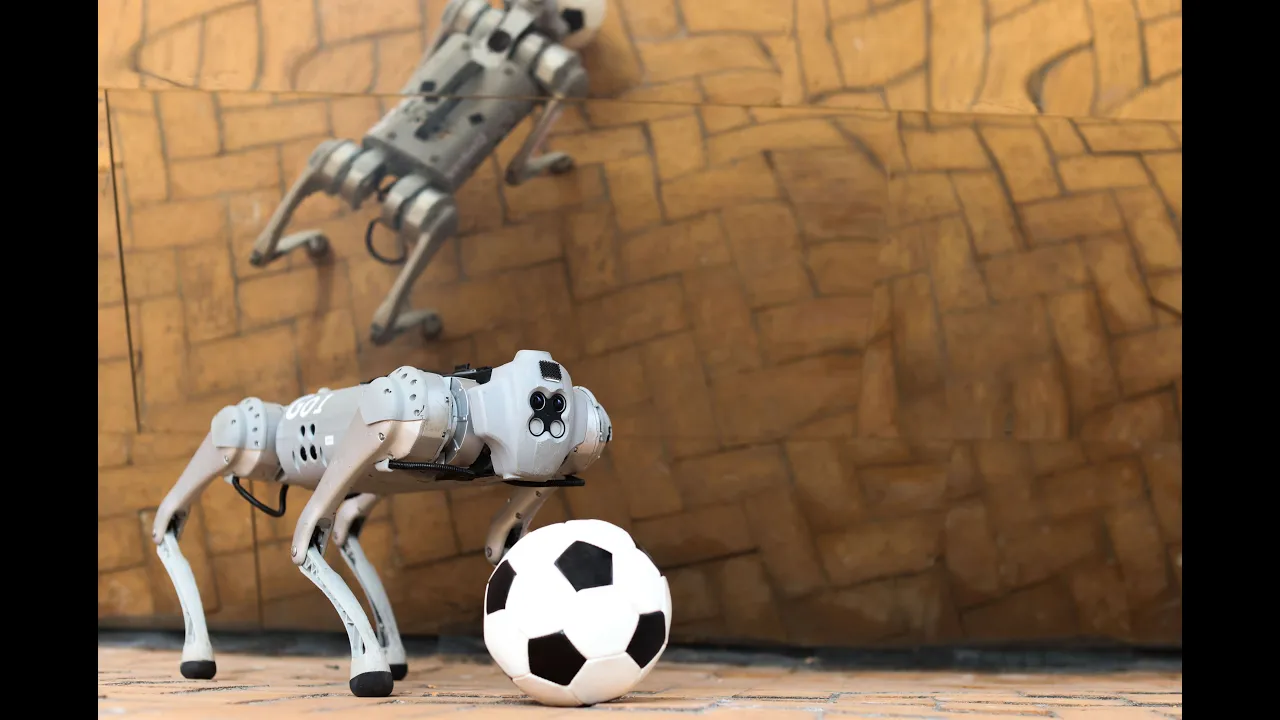

The answer to all of the above is familiar to anyone familiar with the field of robotics lately: simulation, simulation, simulation. In training, the physical robot is considered a “digital twin” as computers run 4,000 simultaneous simulations of different environments. This particular type of training clearly has wider application than the admittedly narrow world of robot soccer. The debate surrounding the effectiveness of legged robots continues, but one thing is certain: There are limits to how far we can currently go using wheels.
If you look around today, most robots are wheeled. But imagine there is a disaster scenario, a flood or an earthquake, and we want robots to help with search and rescue operations. We need machines that can traverse uneven terrain, enter hard-to-reach places, or easily overcome obstacles that wheeled robots can’t,” says MIT professor Pulkit Agrawal. The whole point of studying legged robots is to go into territories that are not accessible by current robotic systems.” Of course, Dribblebot has its limitations. Stairs and steep inclines are still a challenge for this little robot.
0 Comments