
Scientists are trying to answer the question of how the Sun will die. The human species probably won’t be here to see it with their own eyes, as the odds say we’ll either be extinct or moved to another solar system.
Until today, scientists believed that our Sun would turn into a planetary nebula, full of gas and cosmic dust, until the latest data shows that the end of our solar system will be more spectacular. In 2028 scientists found that a planetary nebula is a dead planetary system, that’s why we thought until today, that this is the end of our own system. The Sun is 4.6 billion years old, as measured by other objects in our solar system that formed around the same time. Based on the observations of astronomers, the end of our solar system will come in 10 billion years. Of course by now, there will be plenty of things to do in between. For example, in 5 billion years, the Sun will turn into a red giant. Its core will shrink, but its outer dimensions will expand, destroying Mars and engulfing Earth. They want to blast the lunar soil with lasers to make roads Humanity has about 1 billion years to go unless we find a way to get off the planet, unless of course we destroy it first.
This happens because the Sun increases its brightness by 10% every billion years. This may not seem like something terrible, but a 10% increase in the brightness of the Sun means the end of life on Earth. Oceans will evaporate and the surface of the planet will become too hot to hold water. These are more or less known, but what happens after the sun turns into a red giant is difficult to predict. Previous studies have shown that for our solar system to become a bright nebula, a star with twice the size of the Sun is needed. In 2018, a study used simulation to determine what happens next.
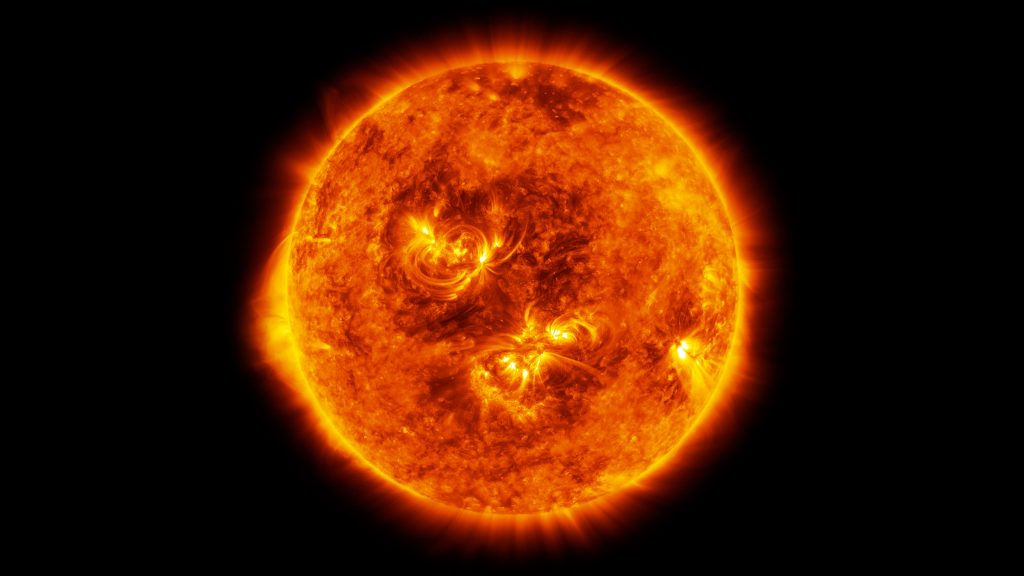
The simulation showed that our Sun would shrink to a red giant and then become a white dwarf, resulting in a planetary nebula. “When a star dies, it ejects a mass of gas and dust – known as its envelope – into space. This envelope can be as much as half the mass of the star. This exposes the star’s core, which at this point in the star’s life is running out of fuel, eventually shutting down and finally dying,” explained astrophysicist Albert Zijlstra from the University of Manchester in the UK, one of the authors of the paper.
Only then does the hot core make the ejecta envelope glow brightly for about 10,000 years – a short period in astronomy. This is what makes the planetary nebula visible. “Some are so bright that they can be seen from extremely great distances, measuring tens of millions of light-years, where the star itself would be too faint to see.” The simulation model can predict the life cycle of different types of stars, to find the luminosity and whether a star system will end up in a nebula, depending on its mass. Nearly 30 years ago, astronomers noticed something strange:
The brightest planetary nebulae in other galaxies are all about the same level of brightness. This means that, in theory at least, by observing nebulae in other galaxies, we can calculate how far away they are. But while the data showed that the calculations were correct, the simulation models showed different results. This worries scientists. “Old, low-mass stars should produce much fainter planetary nebulae than young, more massive stars. This has become a source of conflict in the last 25 years,” Zijlstra said in 2018. “The data said we could get bright planetary nebulae from low mass stars like the Sun, the models said this was not possible, anything less than twice the mass of the Sun would give a planetary nebula too faint to observe.”
The team behind the models came to put an end to the confusion, showing that the Sun has the minimum mass limit for a star to create a visible and bright nebula. In fact, even a star 1.1 times smaller than the sun could shine at its end. Of course, stars three times the size of the Sun produce much brighter nebulae. For all other stars in between, the predicted luminosity is very close to what has been observed.
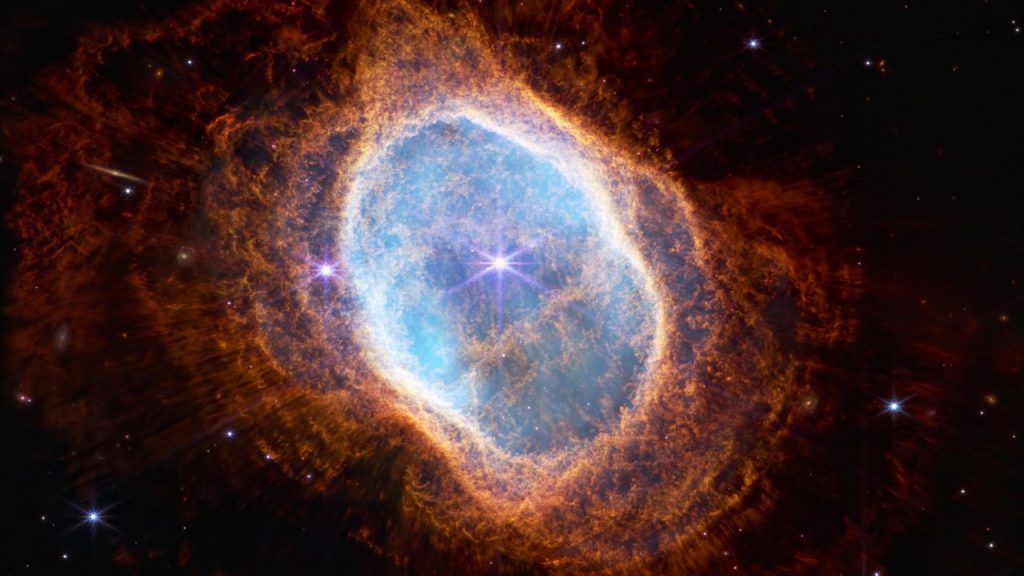
This is a nice result,” Zijlstra said. “Not only do we now have a way to measure the presence of stars a few billion years old in distant galaxies, which is a range that is extremely difficult to measure, but we’ve even discovered what the Sun will do when it dies! ” So, when the end of our solar system comes, it will remain as a bright nebula for several thousand years, being a beacon for the point in the universe where the human species lived and developed.
0 Comments